
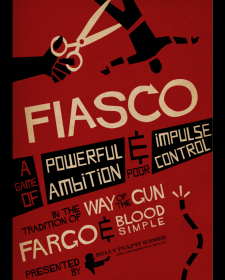
Fiasco Reflection

A game played by creating impromptu narratives, Fiasco turned out to be truly a Fiasco! The narratives my group created had several plot twists and questionable outcomes that had all of our heads spinning. Fiasco, a game unlike others, had a set of rules that were not restricting like other games such as Monopoly and UNO. The rules were more of a guideline that gave my group freedom to make our own choices and essentially create a collaborative story. Playing Fiasco was in some sense writing without physically doing that.

The story our group told ended up with all of us ending up in jail at some point or doing something illegal. Each character faced conflicts that we either took extreme measures to get out of or simply did not resolve the issue resulting in their incarceration or another conflict. In order to even start our narratives, my group members and I had to setup the game which essentially formed an introduction. From the setup the plot slowly unfolded. In many ways, this is very similar to any type of writing that intends to tell a story. There is an introduction giving characters’ identity and purpose, a conflict that the characters must resolve, and an ending where the problems are solved.  Having to go through this process also shed light on the elements of fiction.

Fiasco was essentially creating a fiction. While creating our narratives, my group realized how difficult it was to create one that made sense. It was easy to begin the story, but creating a logical and coherent storyline was difficult. We had to think outside of the box to create new problems and creative solutions that made the narrative interesting. My group started off with two characters getting busted for possession of marijuana, but there were only so many scenarios we could create without being repetitive.

Fiasco was a completely new game to me and very different from the games we played this semester. I had never played a game that had a set of rules, but in the end was mostly open ended to create our own beginning and end. At the beginning, the game was hard since none of my group members or I had played a game like this. We were not sure if we were doing it correctly, causing us to be hesitant when first creating our narrative. I was thoroughly pleased with the results we came up with though. After figuring out, the storyline quickly picked up.

Fiasco was the first role-playing game I have played, and I believe it was rewarding in doing so. Playing a game rather than actually writing those narratives shed light onto the writing process for fiction works and allowed us to have a different perspective on games in relation to writing. Fiasco essentially allowed my group members to work collaboratively rather than work against each other like we would in a typical game. In the future, I believe having the experience of playing this role-playing game will further improve my writing.

Fiasco

A game of fiasco!


What a fiasco…


In a flurry of narratives and laughs, I found myself at the conclusion of the grand story that our group created for ourselves. After a series of Wild West murders and opium drug deals, I found myself killed in the middle of a family opium operation. As the dust of Boomtown settled on the piles of cash and dead bodies of the narrative, my group felt an extensive assortment of emotions. Instead of a structured game, Fiasco revealed itself as a freeform narrative. The story was created together, which resulted in a feeling of collaborative story telling.

I was pleasantly surprised to realize that our narrative followed the pattern of events and actions of literary works. A clear introduction, complications, climax, and conclusion were evident in our crazy story. This was due in respect to the nature of the game that laid out a setup, act one, and act two. Majority of the introduction was established in the setup of the game. This stage was a stilted in comparison because we had a hard time finding a starting point. We were all new at the game, so it was hard to figure out the game parameters and play at the same time. Complications arose primarily in Act one when the needs of the characters began to clash. The climax was found in the Tilt phase in which the story took unexpected turns. For example, Frunk Trump’s prized Colt Revolvers were stolen by Killary Hilton, who was ultimately betrayed by her cousin, Lucy Kane. Killary Hilton went on crazy kill-rampage that ended in the deaths of side characters in the narrative. Most of the conflicts were forms of external issues. The conclusion was formed in the aftermath of Act 2.

Visual snapshots of the game in the early and late phases would serve to hugely juxtapose one another; in the beginning, we were all very confused and rigid in creativity. As the game quickly picked up, crazy narratives were formed, and the story quickly turned out of control. This made us realize how self-perpetuating plot formation was for writers or game developers. The narrative developed on itself as both logical progressions and unexpected tilts nurtured and energized the story. Not only did the narrative develop, but also the roles that we all took. Instead of acting out the game, we collective told a story in which we all contributed to. Clear personalities and character traits were made apparent for each player in Fiasco as we role-played the story in natural progression.

Playing Fiasco proved to provide a unique experience that was much unlike most of the work that I completed this semester. This game was more of a literary narrative than an analytical assignment or game. Since we all just contributed to the narrative on the spot, the story was not carefully constructed. From that, I learned to find a balance in my writing between creative idea sketching and structured plot making. Too much of one aspect leads to either an entirely unstructured plot or a stilted progression in the narrative.

Bloons Tower Defense and Habituation Podcast Reflection

Before my co-producer and I started the podcast, we discussed both of our personal experiences about the game. We also decided to not include live gameplay in our podcast because it really doesn’t add anything to our discussion. All you would hear are balloons popping and maybe us saying what towers we put down. The listener wouldn’t understand what is happening. This is how our podcast differed from the others in this series. We kept the format for the rest though. We started by saying what the game is about and then incorporated the Bogost term afterwards. However, instead of gameplay, we discussed our personal experiences with the game and how it made for a social interaction between people.

The goal of our podcast was to explain how Bloons Tower Defense exemplifies habituation and also creates a social opportunity for all the people who play it together. We did have to discuss the negative effect of habituation of these games as well. They are very addictive and distract mostly students from their work. We talked about the positives of the game in that it is ideal for completionists and it is a good way to ease your mind if you are really stressed.

The learning outcome we used the most on this projects was collaboration because we had to discuss with each other what to do and how to do it.

Click here to view the podcast

Reflection – Wolf in White Van

Wolves by flickr user AdamHallArt

Thought is an unruly gust of wind frantically pushing us towards the limit of our minds. It refuses to obey the helm despite numerous efforts to keep it in control. While inspiration and invention often participate in such mental flourish, its capricious nature at times worries us with anxiety and irresistible impulses, leading us towards unforeseen tilt — accidents — or even devastating outcomes such as suicide.

My analysis on John Darnielle’s Novel, Wolf in White Van, centers around the transformation of Sean from unable to resist bad thoughts, resulting in the traumatic event of he shooting himself, to controlling his imagination and resting it in his game, Trace Italian, through which he slowly recovers and gains access to the outside world.

The assignment helped me improve my critical thinking and reading resulting in writing skill. I learned to use ideas from the work as a way to analyze the book from my own perspective. I integrated the author’s point of view into my essay and bridged the gap between his interpretation and my argument. Another learning outcome is rhetorical composition. This assignment is very different from Unpacking Manuel’s Tavern and therefore I had to compose it in a different way. I assumed that the audience didn’t know much about the novel so I tried my best to guide them towards getting a sense of what it is about while at the same time understanding my main argument.

Wolf in White Van

“Depression” by Flickr Images

Hello everyone,

I would love it if you could take the time to read my interpretation of how John Darnielle’s novel Wolf In White Van explores the ways in which a young man copes with trauma through escaping the world around him with games. I also discuss the author’s use of limited range of narration as well as his effective development of the plot. Check it out!

(Untitled)

Hello everyone,

“Depression” by Flickr Images

I would love it if you could take the time to read my interpretation of how John Darnielle’s novel Wolf In White Van explores the ways in which a young man copes with trauma through escaping the world around him with games. I also discuss the author’s use of limited range of narration as well as his effective development of the plot. Check it out!


Wolf in White Van

How does trauma relate to the human mind and how does trauma affect the way we perceive life and how our brains process trauma. John Darnielle explores the ideas of trauma and story telling in his novel Wolf in White Van. But how do we know what trauma is without the tell-tale signs of a catastrophic event, can someone experience trauma without something devastating occurring. Read more in my essay here.

Personally, I felt like this assignment helped me fulfill the Critical Thinking and Reading Resulting in Writing. Reading Wolf in White Van and analyzing it made me draw different connections between what the author perhaps intended to draw as well as the connotations it makes to the world we live in. After reading the book, writing about various aspects about how the book deals with trauma made me think about how many people have these experiences in real life. I was also able to draw various connections between parts of the book and how the story was tied up together.


Picture


Analyzing “Wolf in White Van”

“Maze” by Jay


I invite everyone to read my take on the impact of trauma in Wolf in White Van by John Darnielle. Utilizing the structural uniqueness of the narrative and the importance of refuge, I discussed the impetus in which drives the effects of perspective in understanding trauma. In particular, the second learning objective, Critical Thinking and Reading Resulting in Writing, was used in formulating my arguments. I hope to see everyone there!

1 … 3 4 5 6 7 … 24